

Rock anchors
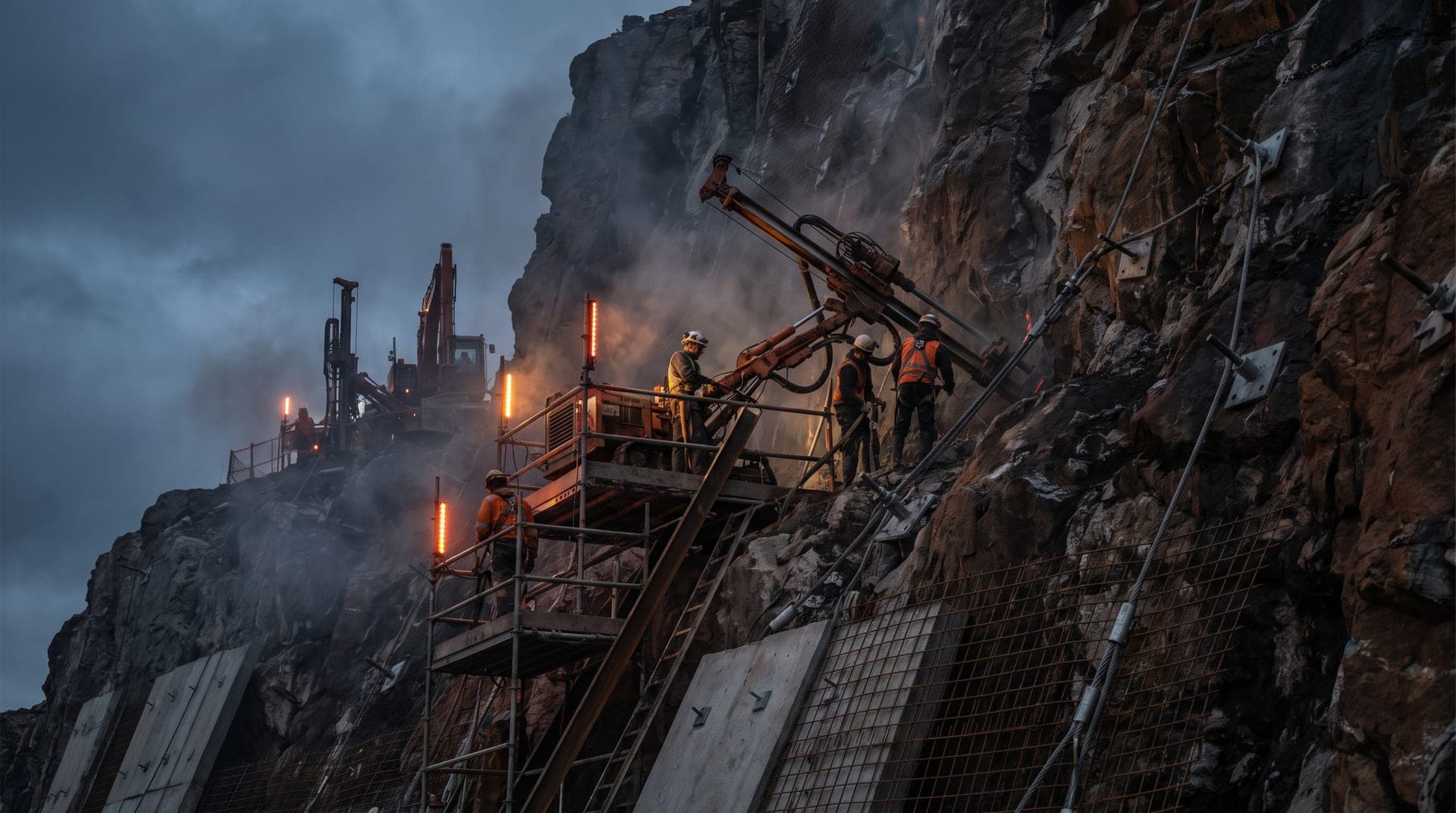
Anchors transfer tensile forces from the structure deep into the ground. We stabilise excavations, slopes and rock faces — temporarily or permanently.
Rock anchors transfer tensile forces from structures into the rock mass. They are used to stabilise excavation pits, slopes and rock cuts, and to hold down structures against water uplift.
We install temporary and permanent anchors, bar and strand types, including stressing and acceptance tests. Anchoring is combined with soldier-pile walls, shotcrete or micro-pile walls as the project requires.
Key benefits
Temporary & permanent
Type and corrosion protection matched to the design life.
Stressing & testing
Every anchor stressed and tested to standard — capacity documented.
Slopes & rock faces
Landslide remediation, road and railway cuts, rock walls.
Against uplift
Tying down base slabs and structures below groundwater level.
How the work proceeds
- 01
Structural design
Capacity, length and inclination per loading.
- 02
Drilling & installation
Borehole execution, tendon installation.
- 03
Root grouting
Grouting the bond length to transfer forces into the ground.
- 04
Stressing & test
Stressing to design load with acceptance test.
Frequently asked questions
What is the difference between temporary and permanent anchors?
A temporary anchor serves during construction (typically up to 2 years); a permanent one is part of the structure for its whole design life and has enhanced corrosion protection.
How is anchor capacity verified?
By a stressing test — the anchor is loaded to the test force per standard and deformations are measured. Every anchor gets a protocol.
Do you anchor rock faces along roads?
Yes, stabilising rock cuts along roads and railways is common in our portfolio, often combined with mesh and shotcrete.
Related services
Got a project that needs special foundation work?
We'll prepare a solution proposal and price quote free of charge. We just need a few details about the construction.